
The Hidden HIPAA Risk in Your Senior Living Community (That No One Talks About)

It's 7:45 in the morning and one of your care aides is already on her feet. She's helped two residents get dressed, fielded a question from a family member at the front desk, and just finished documenting morning vitals. Her phone buzzes — it's the daughter of a resident in Room 112 asking for an update on her mom's night. The aide types back a quick reply from her personal iPhone: "She slept well, had a good breakfast, seemed in good spirits."
Seems harmless. It's actually a HIPAA violation.
Not because the aide did anything malicious. Not because the information was sensitive in a dramatic way. But because that message — sent from an unencrypted personal device, with no audit trail, no organizational oversight, and no Business Associate Agreement in place — contains protected health information transmitted through an unsecured channel. And this exact scenario is playing out dozens of times a day in senior living communities across the country.
The hidden HIPAA risk most operators aren't talking about isn't an EHR breach or a paper record left on a counter but the personal cell phone sitting in your care aide's scrub pocket.
Why Senior Living Communities Face Unique HIPAA Exposure
The first question operators often ask is whether HIPAA even applies to their community. The answer depends on your service model — but for most senior living providers, the answer is yes, at least in part.
HIPAA applies to covered entities, which include healthcare providers that transmit health information electronically, health plans, and healthcare clearinghouses. Many senior living communities — particularly those offering skilled nursing, therapy services, or care coordination with physicians and hospitals — meet this threshold. Even communities that don't qualify as covered entities directly often work with covered entities in ways that create overlapping compliance obligations.
What makes senior living particularly vulnerable isn't the clinical side of care. It's the human side. Families are emotionally invested, residents need frequent updates, and staff are naturally inclined to be responsive and caring. That combination creates a communication environment that is warm, frequent, informal — and wide open for HIPAA exposure.
The challenge isn't that your team doesn't care about compliance. It's that the very things that make senior living staff great at their jobs — empathy, responsiveness, genuine relationships with families — are exactly what drives them toward communication habits that violate HIPAA communication regulations.
The Personal Cell Phone Problem (The Risk No One Talks About)
Walk through any senior living community during a shift and you'll see staff using personal cell phones. Some communities have policies against it. Most of those policies are inconsistently enforced. And in virtually every community, regardless of policy, staff are using personal devices to communicate about residents in some capacity.
Here's why this matters under HIPAA.
Standard Text Messaging Is Not HIPAA Compliant
SMS texting — the kind used by default on any iPhone or Android — is not encrypted in a way that meets HIPAA's technical safeguard requirements under the Security Rule. When a staff member sends a text from their personal phone containing any information that could identify a resident and relates to their health condition, care, or payment, that is electronic protected health information (ePHI) being transmitted on an unsecured channel.
The Security Rule (45 CFR § 164.312) requires covered entities to implement technical security measures that guard against unauthorized access to ePHI transmitted over electronic communication networks. Standard SMS does not meet this standard — period. It doesn't matter that the message was brief. It doesn't matter that the staff member had good intentions. The transmission itself is the problem.
Personal Devices Are Outside Organizational Control
Even if a staff member uses an encrypted messaging app on their personal phone, the device itself creates a compliance gap. Personal devices are not under your organization's administrative control. You cannot enforce password policies on them. You cannot audit their use. You cannot remotely wipe a personal device if an employee is terminated or if the phone is lost or stolen.
HIPAA's Security Rule requires administrative safeguards that include device management. When ePHI lives on a personal device, you've lost the ability to fulfill those obligations. The moment a staff member texts a resident update and that information is stored in their personal SMS history, you have ePHI sitting on a device you have zero control over.
Photos Are a Particularly High-Risk Area
One of the most overlooked personal cell phone HIPAA risks in senior living involves photos. Staff frequently take photos with personal phones — sometimes to document a wound, sometimes to share a sweet moment with a resident's family, sometimes to show a family member how their loved one is doing. In every one of those cases, if the photo contains an identifiable resident and is related to their health, it is ePHI being captured and stored on an uncontrolled personal device.
When that photo is texted to a family member via iMessage, sent through WhatsApp, or shared in a group chat, that is an unsecured transmission of ePHI. The intent behind the photo is irrelevant to the compliance question.
The Scenarios That Play Out Every Day
The personal cell phone HIPAA risk isn't hypothetical. Here's what it looks like in real life inside senior living communities:
- A family member texts a staff member's personal number asking for an update, and the staff member replies with a brief health status note.
- A care team creates a group text thread on their personal phones to coordinate care — discussing a resident's fall risk, dietary changes, or medication concerns.
- A nurse takes a photo of a wound on her personal phone to document progression, intending to transfer it to the EMR later.
- A staff member calls a family from their personal phone because the community's landline is busy — leaving no record of the call in any system.
None of these feel like HIPAA violations in the moment. They all are. And a thorough HIPAA risk assessment should be catching every single one of them.
What a HIPAA Risk Assessment Should Catch (But Often Misses)
A HIPAA risk assessment is not optional. The Security Rule explicitly requires covered entities to conduct an accurate and thorough assessment of the potential risks and vulnerabilities to the confidentiality, integrity, and availability of ePHI (45 CFR § 164.308(a)(1)). It must be documented, and it must be updated when operations change.
Most organizations conduct risk assessments that focus on the obvious targets: EHR systems, physical record storage, network security, access controls. These are important. But they represent only part of the picture — and they frequently miss the informal communication layer entirely.
The Questions Most Risk Assessments Don't Ask
A truly comprehensive HIPAA risk assessment for a senior living community needs to go beyond the IT infrastructure and ask hard questions about how people are actually communicating day to day.
How are staff communicating with families about resident health? Not how your policy says they should. How they actually are. If you don't know, you should find out — through staff surveys, walkthroughs, or honest one-on-one conversations.
Are personal devices being used for any resident-related communication? This includes texting, calls, photos, app-based messaging, and group chats. If staff don't have a convenient compliant alternative, the answer is almost certainly yes.
Is there a sanctioned HIPAA-compliant channel for care team communication? If your team is coordinating care informally — which all care teams do — is that happening in a compliant environment or a personal group chat?
Have staff been trained on what constitutes ePHI in a communication context? Most HIPAA training covers records and documentation. Very little covers the real-world question of what happens when you text a family member.
If your last HIPAA risk assessment didn't ask these questions, it has gaps. And those gaps represent real exposure.
HIPAA Communication Regulations: What the Rules Actually Require
There's a lot of confusion about what HIPAA communication regulations actually demand. Let's cut through it.
The Privacy Rule
The Privacy Rule governs who can access and receive PHI. For senior living communities, this means that sharing a resident's health information with family members requires proper authorization — either the resident's written consent or a documented determination that sharing with a specific person is in the resident's best interest.
Getting verbal authorization from a resident to update their family doesn't make the method of communication compliant. It only addresses the permission question. The Privacy Rule and the Security Rule both have to be satisfied, and they address different things.
The Security Rule
The Security Rule governs how ePHI is stored, accessed, and transmitted. It requires three categories of safeguards: administrative, physical, and technical. Standard text messaging fails on the technical side. Personal devices fail on the administrative side. Both failures are independent HIPAA violations.
The Security Rule doesn't specify which technologies you must use — it sets standards and allows organizations to choose compliant solutions. But it is clear that any transmission of ePHI must be protected by appropriate encryption and access controls. Consumer-grade SMS does not qualify.
The Breach Notification Rule
Here's where personal cell phone use becomes especially dangerous. If ePHI is improperly disclosed — say, a staff member texts a resident update to the wrong number, or a personal phone is lost — that may trigger a reportable breach under HIPAA's Breach Notification Rule.
A reportable breach requires notifying the affected individual, the Secretary of HHS, and potentially the media if the breach affects 500 or more people. Even small breaches create documentation obligations and potential penalties. And the reality is that when ePHI lives on personal cell phones, breaches are far harder to detect and far easier to miss.
The Misconception That Keeps Coming Up
One of the most common misunderstandings in senior living is this: "We have the resident's permission to update their family, so we're covered." Consent to share information is not the same as compliance with the method of transmission. You can have all the right authorizations in place and still be violating HIPAA communication regulations if you're using an unsecured channel to deliver that information.
The Compliance Gap Is a Culture Problem, Not Just a Policy Problem
Most senior living communities have a written cell phone policy. It probably says something like: personal phones are not to be used for resident communication. It is probably not consistently followed.
This isn't because your staff are careless or indifferent. It's because they've been given a rule without being given a workable alternative. Compliance doesn't happen in a vacuum. When staff are busy, understaffed, and genuinely trying to serve families well, they default to what's convenient. Right now, what's convenient is the phone in their pocket.
Fixing the personal cell phone HIPAA risk requires three things working together: a clear policy, meaningful training on why the policy exists, and a practical compliant alternative that staff can and will actually use. Remove any one of those three elements and the gap stays open.
Compliant communication tools for senior living generally need to be encrypted, operate under a Business Associate Agreement with your organization, maintain an audit log of communications, support role-based access controls, and be accessible on the devices staff already use — whether that's a shared community tablet or a personal phone running an approved app.
The goal isn't to make communication harder. It's to make compliant communication just as easy as non-compliant communication. When you achieve that, behavior changes.
Steps to Close the Gap — Starting with a Risk Assessment
The good news is that this is a solvable problem. Here's how to approach it systematically.
Step 1: Conduct or update your HIPAA risk assessment with communication in scope. If your last assessment didn't explicitly address how staff communicate with families and care teams, it needs to be updated. Document the assessment process, the findings, and your remediation plan.
Step 2: Audit actual communication practices. Survey staff anonymously if needed. Ask directly how they're communicating with families and with each other. You may be surprised — or you may confirm what you already suspected. Either way, you need accurate information before you can address the problem.
Step 3: Establish a clear, enforceable policy. The policy should specify what channels are approved for resident communication, explicitly prohibit personal device use for ePHI transmission, and outline consequences for violations. Make it simple and specific enough that there's no ambiguity.
Step 4: Provide a compliant alternative and make adoption easy. Choose a platform that has a signed BAA, supports encryption at rest and in transit, and is genuinely usable in a care environment. Train staff on how to use it before enforcing the policy.
Step 5: Train on the why, not just the what. Staff who understand that a family text could trigger a breach investigation are more motivated to comply than staff who've just been told "no personal phones." Connect the rule to the real-world consequences.
Step 6: Document everything. Training completion, policy acknowledgment, risk assessment updates, BAAs with technology vendors. Documentation is your evidence of good faith if you're ever subject to an OCR investigation.
he Risk Is Hiding in Plain Sight
The biggest HIPAA risk in your senior living community right now probably isn't your EHR system. It isn't your paper records. It's the casual, well-intentioned, genuinely caring communication happening between your staff and your residents' families — on personal phones, through unencrypted text threads, with no audit trail and no organizational oversight.
That doesn't make your staff bad at their jobs. It makes them human. But it does make your community vulnerable in a way that a standard HIPAA risk assessment often fails to surface — and that OCR investigations increasingly do find.
The fix isn't complicated. It starts with an honest look at how your community communicates, a risk assessment that doesn't stop at the IT closet, and a commitment to giving your team the tools they need to protect residents and the organization at the same time. That's exactly what Caily was built to do. Caily is a HIPAA-compliant communication platform designed specifically for senior living communities — giving staff a secure, encrypted channel to send family updates, coordinate care, and document communications, all without touching a personal text thread. With a signed BAA, a full audit log, and an interface simple enough that staff adoption happens immediately, Caily replaces the path of least resistance with one that's actually compliant. When your team has a tool that's just as easy to use as their personal phone — but built to protect your residents and your organization — the compliance gap closes itself.
Frequently Asked Questions About The Hidden HIPAA Risk in Your Senior Living Community
Does HIPAA apply to senior living communities?
Most senior living communities — especially those offering skilled nursing, therapy, or care coordination — qualify as covered entities under HIPAA and are fully subject to its requirements. Even communities that don't meet that threshold directly often carry compliance obligations through their relationships with covered entities.
Is texting a resident update from a personal phone really a HIPAA violation?
Yes — standard SMS is not encrypted to the level required by HIPAA's Security Rule, making any resident health information sent via personal text a non-compliant transmission of ePHI. The intent behind the message and how routine the information seems don't change the analysis.
How often should a senior living community conduct a HIPAA risk assessment?
Most compliance experts recommend conducting a HIPAA risk assessment at least once a year, and any time there is a meaningful change to your technology, operations, or care model. The Security Rule requires it to be ongoing — not a one-time checkbox.

Get Started Now
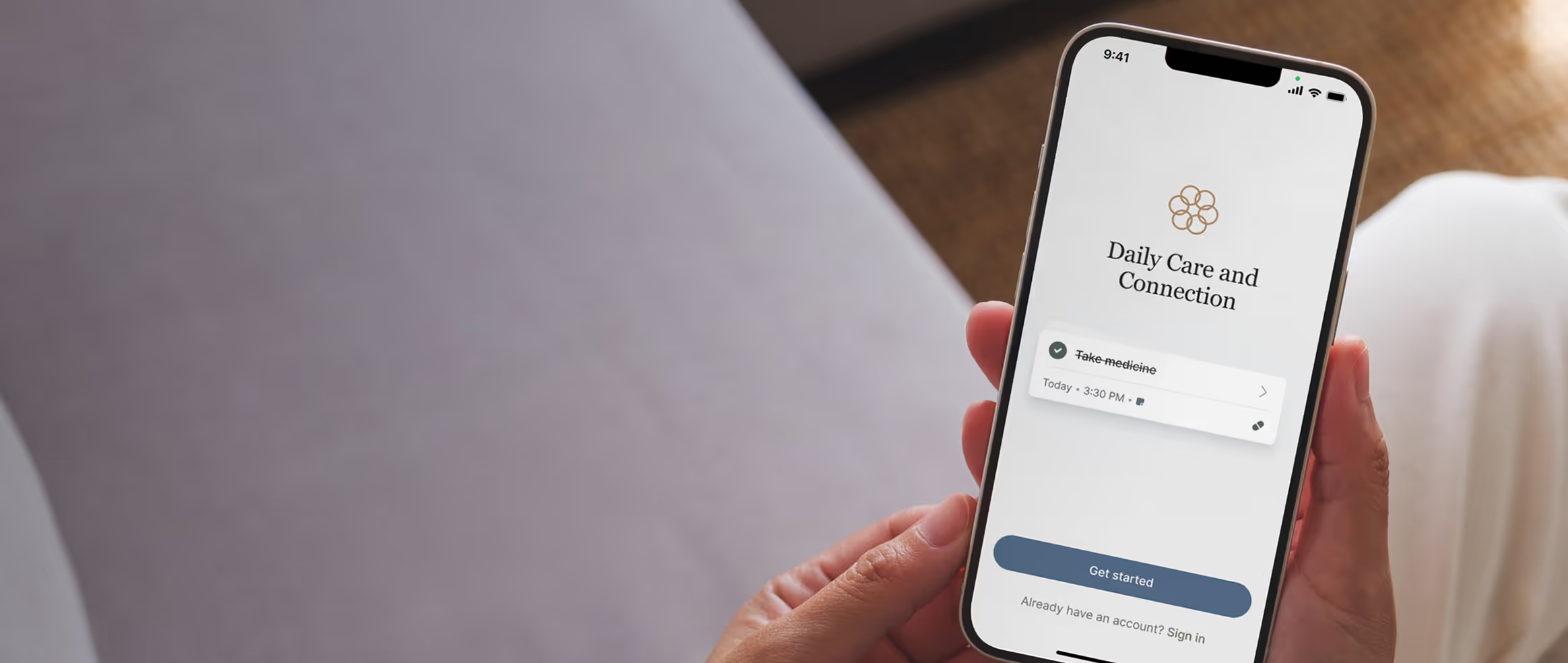
Enjoy full access to everything Caily offers, from medication tracking to shared schedules and daily check-ins. See how much easier caregiving can be when everything is coordinated in one place.
Start your free trial