
Activities for Residents with Dementia: Meaningful Engagement That Actually Works
When a loved one moves into a memory care community, one of the first questions families ask is: what will they do all day? It is a fair question, and the answer matters more than most people realize. For people living with dementia, daily engagement is not a pleasant extra — it is a clinical necessity. The right activities for residents with dementia can slow cognitive decline, reduce anxiety and agitation, improve mood, and support a genuine sense of purpose and belonging.
But not all activities are created equal. Programming that works in assisted living does not automatically translate to memory care. Understanding what kinds of engagement are meaningful for people living with dementia, why they work, and how to deliver them in a way that respects individual identity is what separates communities that simply fill time from those that genuinely enrich lives.
Why Activities Matter More Than You Think
The research on engagement and dementia is clear and consistent. According to the Alzheimer's Association, staying physically and mentally active can help maintain function and quality of life for people living with dementia. Studies published through the National Institute on Aging have found that regular engagement in meaningful activities is associated with a lower risk of cognitive decline and improved emotional well-being across all stages of dementia.
This matters because dementia affects more than memory. It affects mood regulation, impulse control, and the ability to manage anxiety and distress. Unstructured time — long stretches with nothing meaningful to do — is strongly associated with increased behavioral symptoms like agitation, wandering, and emotional outbursts. Meaningful engagement is one of the most effective, lowest-risk interventions available. It does not require a prescription. It requires intention.
The Difference Between Busy and Meaningful
There is an important distinction between filling time and creating genuine connection. Scheduling back-to-back group events does not guarantee that any individual resident is truly engaged. In fact, programming that is not calibrated to a person's history, abilities, and preferences can leave residents feeling more isolated than if they had been left alone.
Dr. Al Power, whose work on dementia care has influenced communities across the country, argues that the best approach is to care for people who happen to have dementia — not to run a dementia program. That framing shifts everything. It means starting with who someone is, what they loved, what gave their life meaning, and building from there, rather than defaulting to a one-size-fits-all calendar of group activities.
Activities That Work Well for People Living with Dementia
Effective activities for residents with dementia share a few common qualities: they are rooted in the person's history, they match the person's current ability level, they invite participation without demanding performance, and they create an opportunity for genuine pleasure or connection. The goal is never to challenge or correct — it is to support a meaningful moment.
Music and Reminiscence
Music is one of the most powerful and well-documented tools in dementia care. The Music and Memory program, which has been implemented in senior living communities across the country, is grounded in research showing that personalized music activates areas of the brain that remain intact even in advanced dementia — areas connected to memory, emotion, and identity. A person who can no longer recall a grandchild's name may still sing every word of a song from their twenties.
Reminiscence activities build on the same principle. Looking through photo albums, handling familiar objects from the past, or discussing historical events from a person's lifetime can spark engagement and genuine emotional connection. These activities work best one-on-one or in very small groups, with a caregiver who knows the person's history well enough to guide the conversation gently.
Sensory and Tactile Engagement
Sensory activities are particularly effective for people in the middle and later stages of dementia, when verbal communication becomes more difficult. Handling different textures, arranging flowers, folding towels, working with clay, or tending to a small garden bed can provide meaningful engagement that does not require memory or complex reasoning — just sensation, rhythm, and presence.
These activities are also deeply dignity-affirming. A person who spent decades cooking, sewing, or working with their hands does not stop feeling capable when given familiar tools and a simple task. The activity may look different than it once did, but the satisfaction of doing something purposeful is real.
Gentle Movement and Physical Activity
Physical activity has a documented impact on dementia symptoms. The CDC and Alzheimer's Research & Prevention Foundation both highlight regular physical movement as one of the most important pillars of brain health. For people living with dementia, gentle options like chair yoga, supervised walking, stretching, dancing, or even passing a ball in a small group can reduce agitation, support sleep, and improve physical function.
Movement activities also carry a social dimension. A slow walk through a garden with a caregiver who is fully present is not just exercise — it is companionship, fresh air, and a brief reconnection with the larger world.
Games, Cards, and Cognitive Engagement
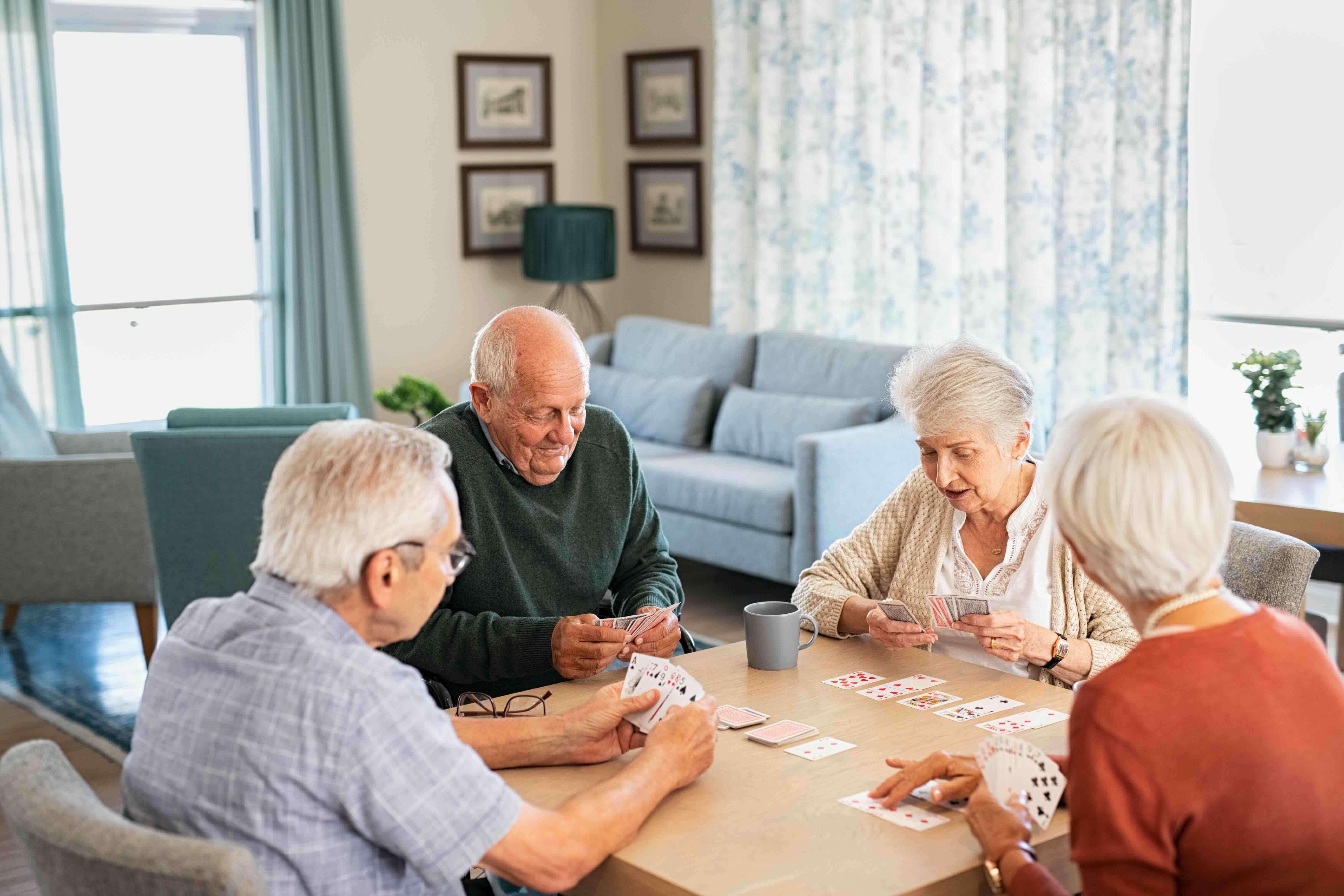
Simple games adapted to a person's current ability can provide meaningful cognitive engagement without frustration. Card games like Go Fish, matching games, simple puzzles, and sorting activities engage attention and reasoning in a low-stakes, enjoyable context. The image of four residents gathered around a card table — laughing, playing, choosing when to draw and when to hold — captures something important: people living with dementia are still social beings who find joy in play and connection.
The key is calibration. Games should be chosen based on what the person can actually do today, not what they could do five years ago. A caregiver who is attuned to a resident's current ability can adapt rules on the fly, let a person lead, and ensure that the experience ends in a moment of success rather than frustration.
Creative Expression
Art, music making, storytelling, and other forms of creative expression give people living with dementia a channel for communication that does not depend on memory or word retrieval. Painting, drawing, simple crafts, and even decorating cookies can produce moments of genuine absorption and pride. Research from the National Endowment for the Arts has documented significant benefits of arts engagement for older adults, including those with dementia, across measures of mood, social engagement, and quality of life.
The product is not the point. What matters is the experience of creating — the focus, the pleasure, the small sense of accomplishment that comes from making something.
The Role of Family in Meaningful Engagement
Families are not passive observers of their loved one's daily life in a memory care community. They are active contributors to it. A family member who shares a detailed life history with care staff — what their loved one did for work, what music they loved, what they were proud of, what they found funny — gives the care team invaluable information for building activities that truly resonate.
Families also provide something no programmed activity can fully replace: the presence of someone who loves the resident unconditionally. Regular visits, video calls, and consistent communication between families and care teams create a continuity of relationship that is one of the most powerful sources of well-being for people living with dementia. Even when a resident cannot remember that a visit happened, the emotional residue of connection remains.
This is one of the reasons that family communication tools like Caily matter in memory care settings. When families receive consistent daily updates — whether their loved one slept well, participated in the morning walk group, or lit up during the music session — they stay genuinely engaged in their loved one's world. That engagement translates into richer conversations during calls, more informed advocacy, and a stronger partnership with the care team. In memory care especially, where residents often cannot report their own experiences, keeping families informed is not just good service — it is part of the care.
What Families Should Ask Their Community
If your loved one lives in or is transitioning to a memory care community, it is worth asking specific questions about how engagement is approached. How does the community learn about each resident's history, interests, and preferences? How does the activities programming adapt as a resident's abilities change? Are there one-on-one engagement opportunities in addition to group programming? How does the team communicate with families about how a resident spent their day?
The answers to these questions will tell you a great deal about whether a community sees residents as individuals with full histories and rich inner lives, or simply as people requiring supervision and a schedule.
When Connection Is the Activity
The most meaningful engagement for a person living with dementia is often the simplest. A caregiver who sits beside a resident and simply listens. A cup of tea shared without any agenda. A few minutes of familiar music in a quiet room. These moments do not make it onto a programming calendar, but they are often what residents remember in the deepest, wordless way — and they are always available to families who choose to show up.
Activities for residents with dementia will always matter. But the quality of human connection surrounding those activities matters just as much. Communities that understand this build something rare: a place where people living with dementia are not managed — they are known.
Frequently Asked Questions About Activities for Residents with Dementia
What types of activities are best for people with dementia?
The most effective activities for people living with dementia are rooted in the individual's personal history, match their current cognitive and physical ability, and invite participation without creating pressure or frustration. Music, reminiscence activities, gentle movement, simple games, sensory tasks, and creative expression are all well-supported by research. One-on-one engagement is often more meaningful than large group activities, particularly as dementia progresses. The most important factor is knowing the person — their history, their interests, and what has always brought them joy.
How do activities help people living with dementia?
Meaningful engagement supports cognitive function, reduces behavioral symptoms like agitation and wandering, improves mood, and contributes to a genuine sense of purpose and belonging. The Alzheimer's Association and National Institute on Aging both identify regular activity as a key component of quality care for people with dementia. Beyond the clinical benefits, activities provide something equally important: moments of genuine pleasure, connection, and dignity in daily life.
How should activities be adapted as dementia progresses?
As dementia progresses, activities need to become simpler, more sensory-based, and more supported by caregivers. Early-stage residents may enjoy books, music, complex games, and group conversations. In later stages, the focus shifts to sensory engagement — textures, familiar smells, soothing music, gentle touch, and the simple pleasure of being in someone's caring presence. The goal at every stage is not to challenge the person, but to meet them exactly where they are and create a moment of genuine connection.
Can families participate in activities with a loved one who has dementia?
Absolutely — and family participation can be one of the most meaningful forms of engagement available. Shared meals, listening to music together, looking through old photographs, or simply sitting together during an activity can be profoundly connecting experiences. Families should communicate with the care team about what their loved one responds to and what their personal history includes, so that visits can be designed around what is most likely to create genuine moments of joy and recognition.
How does a memory care community communicate activity participation to families?
This varies significantly by community. The best communities provide families with consistent, specific updates about how their loved one spent the day — not just whether they attended an activity, but how they responded to it. Did they light up during the music? Did they laugh with another resident during the card game? These small details are enormously meaningful to families who cannot be present every day. Platforms like Caily allow care teams to share this kind of daily information directly with families in a simple, HIPAA-compliant format, keeping families genuinely connected to their loved one's daily life regardless of distance.
What should families look for when evaluating a memory care community's activity program?
Look for evidence that programming is individualized rather than generic. Ask how the community learns about each resident's history and preferences. Ask whether activities are adapted as needs change, and whether there are one-on-one engagement opportunities alongside group programming. Pay attention to how staff talk about residents — whether they speak about them as whole people with full lives and identities, or primarily in terms of their diagnosis and care needs. A community that sees the person behind the dementia will build programming that reflects that vision.